


.jpg)
Why Diesel Exhaust Systems Crack Over Time?

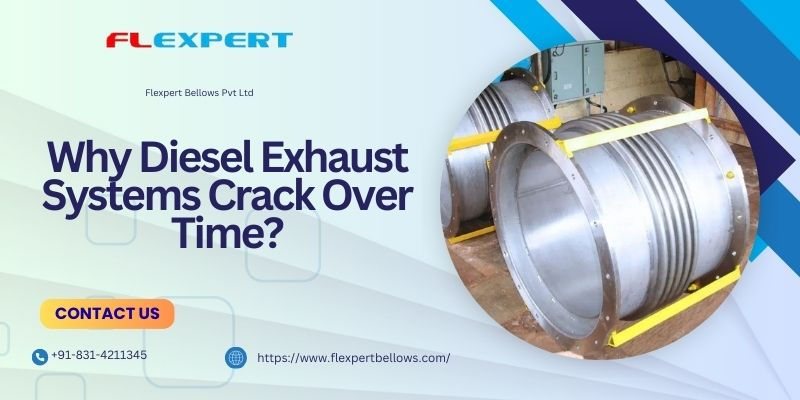
Anyone who has worked around diesel engines-on highways, at construction sites, or inside power plants-has seen it happen. Pipes crack, joints loosen, and systems that once ran quietly begin to rattle and leak. The invisible culprit behind many of these failures is thermal cycling. It’s a simple idea, but its long-term impact on diesel exhaust systems is anything but simple.
In India, where diesel engines power everything from long-haul trucks to backup generators, thermal cycling places enormous stress on components like Diesel exhaust expansion joints. Understanding how this process works can mean the difference between smooth operation and repeated, expensive repairs.
What Is Thermal Cycling, Really?
Thermal cycling refers to the repeated heating and cooling of materials during normal engine operation. Every time a diesel engine starts, exhaust temperatures rise rapidly-often several hundred degrees Celsius. When the engine shuts down, everything cools again. This expansion and contraction happens thousands of times over a system’s life.
Metal doesn’t mind heat. What it struggles with is constant movement. Each cycle causes microscopic changes in length and shape. Over time, those tiny movements add up, leading to fatigue, cracks, and eventual failure. According to materials research summarized by the National Institute of Standards and Technology (NIST), repeated thermal stress is one of the most common contributors to metal fatigue in industrial systems.
Why Diesel Exhaust Systems Are Especially Vulnerable?
Diesel exhaust environments are harsh by design. High temperatures, pressure pulses, vibration, and corrosive gases all work together. Add India’s operating realities—long idling hours, stop-start traffic, fluctuating loads—and thermal cycling becomes more aggressive.
Common stress points include:
Rigid pipe sections: Long straight runs expand significantly and have nowhere to relieve stress.
Welded joints: Heat-affected zones are often the first to crack under repeated cycling.
Mounting brackets: These absorb movement they were never designed to handle.
In many fleets and industrial setups, failures are misattributed to “poor material quality,” when in reality the design didn’t account for thermal movement at all.
The Role of Flexible Components in Managing Heat
This is where intelligent exhaust design steps in. Flexible elements are introduced to absorb expansion, vibration, and misalignment. Midway through the exhaust line, components like exhaust pipe bellows act as shock absorbers for heat.
Rather than forcing the entire system to fight physics, bellows and flexible joints allow controlled movement. They compress, extend, and flex-protecting rigid sections from stress buildup. In high-duty diesel applications, this flexibility often determines whether a system lasts five years or fifteen.
Key benefits of flexible exhaust design:
Reduced metal fatigue by allowing natural expansion.
Lower vibration transfer to turbochargers and manifolds.
Improved sealing during temperature fluctuations.
Thermal Cycling in Indian Operating Conditions
Indian diesel engines rarely enjoy steady-state operation. City buses idle for long periods, generators kick in during power cuts, and construction equipment faces uneven loads. Each scenario increases the number and severity of thermal cycles.
The U.S. Environmental Protection Agency notes that exhaust components in stop-start duty cycles experience significantly higher fatigue rates compared to continuous-load systems (epa.gov). While the data is global, the insight applies directly to Indian conditions.
This makes the proper selection of exhaust expansion joints not just a design preference, but a reliability requirement—especially in sectors like transport, mining, and power generation.
Design Mistakes That Accelerate Failure
Underestimating temperature ranges during peak loads.
Using rigid connections across long pipe spans.
Ignoring vibration when calculating thermal movement.
These oversights often lead to recurring cracks, gasket blowouts, and unplanned downtime-costly problems that could have been avoided at the design stage.
FAQs
How often does thermal cycling occur in a diesel engine?
Every engine start and shutdown creates one thermal cycle. In urban Indian usage, this can mean multiple cycles daily.
Can thermal cycling cause exhaust leaks?
Yes. Repeated expansion and contraction weakens joints and welds, eventually leading to cracks and leaks.
Are flexible exhaust components suitable for heavy-duty engines?
Absolutely. In fact, heavy-duty engines benefit the most from flexible components designed to handle high temperatures and vibration.
Is thermal fatigue visible during inspection?
Early-stage fatigue is often invisible. By the time cracks appear, damage is usually advanced.
Final Thoughts
Thermal cycling isn’t a flaw-it’s a fact of diesel engine life. The real question is whether an exhaust system is designed to live with it. For Indian industries running engines day in and day out, acknowledging thermal movement and designing for flexibility is not optional. It’s simply smart engineering.
Full Audio: Listen Here
Comments